
Everyone’s talking about AI. Your kids are using it. Your clients probably are, too. And now you’re hearing that you need to show up when people ask financial questions using these tools. So why would I, an expert in marketing for financial advisors, tell you not to make it your top priority?
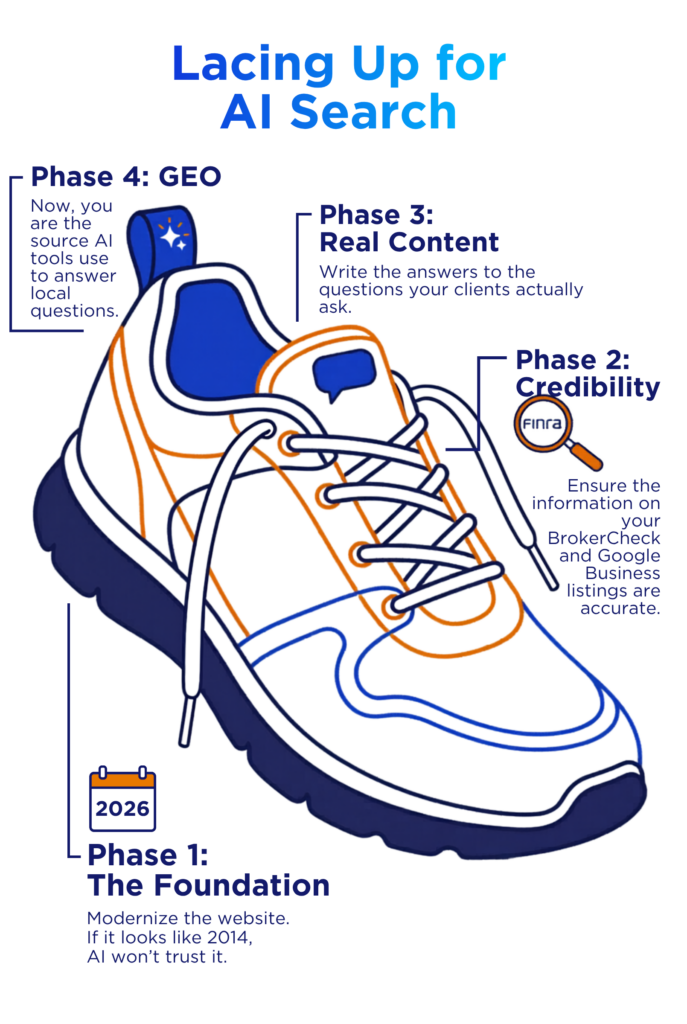
Because for most advisors, jumping straight to AI search optimization is like going for a run without putting your shoes on. The tool is great. The timing is wrong. You need the right foundation first.
But here is the thing — if you do have the foundation, or you are willing to build it, AI search is one of the biggest opportunities independent advisors have seen in years.
First, What Is AI Search — and Why Should You Care?
You already know that traditional search engines like Google gives you a list of links.
AI search tools like ChatGPT, Claude, Gemini or, Perplexity don’t send users to websites. They just… answer you. They summarize what already exists online and present it as a direct response like a knowledgeable friend would.
Like a knowledgeable friend would. A friend who oddly compliments you when you point out their mistake.
Which means: If your content is part of what they find, you become the answer.
And here is the important part: when those AI tools answer a financial question, they pull from content that already exists on the internet. They are essentially saying, “I read everything out there on this topic, and here is the best answer I found.” If your content is what they found — If you are the source they are drawing from — that is incredibly powerful. It’s like being the expert that a very trusted friend recommends.
That’s Generative Engine Optimization (GEO). Or you can call it AEO. You’re wrong, but you can call it that, like the people who say “Jif” instead of “Gif.” It just means making sure that when AI tools go looking for answers to financial questions, they find your content and use it.
How Are People Using AI to Find Financial Help?
This is where things get interesting. People don’t use AI the way they use Google.
What someone types into Google: “financial advisor Charlotte NC
What someone asks an AI:
“I am 54 years old, I have about $400,000 saved, and I have no idea if I am on track to retire at 65. What should I be thinking about? “Do you see the difference? The one using “The Google Machine” is someone who already knows they want to hire an advisor. The AI user is someone who is scared, confused, and trying to figure out if they even have a problem. The AI user is your opportunity.
Think of it like this: Google meets people already at the store. AI meets them while they’re still deciding what they need.
So Why Not Just Jump In? What Is the Foundation Problem?
Because AI pulls from content that already exists.
Here is the honest truth. AI tools do not make up answers from scratch. They pull from content that has already been published online — websites, social media, articles, guides, blog posts. If your website is thin, outdated, or hard to find, there is nothing for AI to find. You’re invisible.
Remember hearing “content is king” for years? I’ve been advising that writing original content is the most impactful, low-cost tactic that advisors should start yesterday. It’s even more true now.
The advisors who consistently created helpful content are ahead. Everyone else is cramming for the test after it’s already started.
It’s like trying to get Yelp reviews for a restaurant that is not listed on Yelp. The reviews can’t exist if the listing does not.
This is why I say the average advisor — the one whose website looks like it was built in 2014 and has not been touched since — needs to fix the foundation before worrying about AI search.
The good news? The work you do to fix your website and start writing helpful content will improve both your Google rankings AND your chances of showing up in AI search at the same time. You’re not choosing. You’re building one foundation that supports both.
You Can’t Beat Forbes. And You Don’t Need To.
This is where most advisors get discouraged.
When you search for almost any financial topic online, who shows up? Forbes. The Wall Street Journal. NerdWallet. Fidelity. These are organizations with huge teams, massive budgets, and decades of history on the internet. How is a solo advisor supposed to compete with that?
You’re not going to out-publish or outspend them. So don’t try. Instead, go where they won’t
Think of it like this. Walmart sells everything. But the local butcher shop sells expertise. A shop that’s been in your neighborhood for thirty years, knows your name, and dry-ages their own beef is not competing with Walmart. They are doing something Walmart fundamentally can’t do. Providing a specialty experience that scale can’t replicate.
Forbes writes for everyone. You can write for someone specific.
They will never write an article for “A Boeing employee in Charlotte trying to figure out what to do with company stock options before retiring in four years.” But you can. And when that person asks an AI that exact question, there may be very few good answers—except yours.
You don’t need to beat Forbes. You need to be the best answer to a question they’ll never write about.
A Real Example: What This Looks Like in Practice
Consider an advisor — let’s call him Brad — who is based in Charlotte, North Carolina. He’s solo, manages $60M, and does not have a big marketing budget.
Brad can’t hire a content team. He can’t run TV ads. He can’t pay to be at the top of Google for competitive keywords. So what can he do?
He Has Advantages the Big Players Do Not
Brad has a name. He has a face. He has a city. And he has years of real conversations with real people who had real financial problems. That’s more valuable than Forbes’ generic content. A national publication can’t explain how a Charlotte nurse should think about her pension, her spouse’s 401(k), and paying off a mortgage before their youngest starts college. Brad can because he’s had that conversation before.
That lived experience, written down in plain language and published on his website, is something no algorithm can replicate. And AI search rewards it — because it’s genuinely useful to the person asking.
What Brad Should Actually Do — Step by Step
Step 1 — Fix the foundation (Months 1 to 3).
Brad’s first job is making sure his website is clean, professional, and clearly explains who he is, who he helps, and where he is located. He should also make sure he is listed accurately in places like Google Business, FINRA BrokerCheck, and any advisor directories. These listings tell AI tools that he is a real, credentialed professional.
Step 2 — Turn conversations into content (Months 1 to 6).
Brad should think about the last 20 client conversations. What questions did they ask? What were they worried about? What did he explain that made them visibly relax? This is his content strategy. He should write down the questions and his answers in plain-language articles. “Here is what I tell people who are worried they are behind on retirement.” “Here is how I think about college savings when money is tight.” They don’t have to be polished or perfect. Just helpful.
Step 3 — Build credibility outside of your website (Months 3 to 9).
One article in the Charlotte Business Journal quoting Brad as a financial expert does more for his credibility — with both Google and AI tools — than twenty posts on his own website. He should pitch local media, offer to be a guest on a local business podcast, or write a guest article for a professional association he belongs to. Every time a credible outside source mentions his name, it’s like a vote that says “this person knows what they are talking about.”
Step 4 — Go deep on the specific people he serves (Month 6 and beyond).
Charlotte is a big city with specific industries — banking, healthcare, energy, technology. If Brad specializes in serving, say, healthcare professionals or longtime employees of one of Charlotte’s major employers, he should become the definitive online resource for that specific group’s financial questions. Not broad. Not general. Specific enough that there is simply no better resource anywhere on the internet for that particular person with that particular situation.
The Bottom Line
AI search isn’t a fad. The way people find information — and find professionals they want to trust with their money — is genuinely changing. Ignoring It’s not a safe option.
But rushing into it without the right foundation is like running a marathon without training. The race is real. The finish line matters. You just need to lace up your shoes in the right order.
The advisors who will win in AI search won’t be the biggest They’ll be the most helpful to a clearly defined group of people — and intentional about putting that expertise into the world. No hacks. No shortcuts. Just clarity, consistency, and content that actually helps.
That is something any advisor can do. Including Brad. Including you.